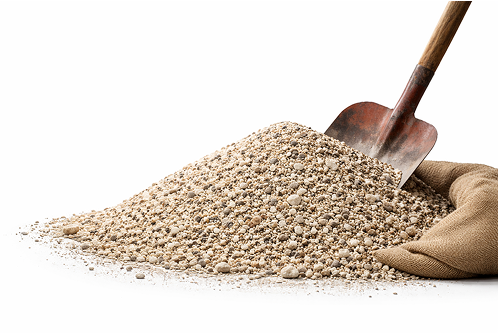
RAMMING MASS
Quartzite ramming Compounds are Generally used for lining Core-less
Induction Furnaces for melting and moulding of Steel, Cast Iron and other
Non-Ferrous Metals.
We are having Mineral chemical Industry with Qualified and Experienced
technicians on this line.
The Raw Material chosen is a high grade Quartzite and it has the
following Advantages.
1.Extremely pure 98%-99% SiO2.
2. Uniform hardness.
3. High degree of refractoriness.
4.Good slag resistance.
Physical Grading Analysis:
Granules – 45%
Powder – 55%
Moisture – 0.2%
Specification:
SiO2 – 98-99% min
Al2O3 — Traces
Iron — 0.5% max
Sintering Porosity – 1200 Degree C
Compression Strength — 350Kg/m3
Bulk Density — 2.0 to 2.2 MT/m 3
Ramming Process Mixing of The Mass
- Work out the Quantity of Ramming Mass Required, the exact amount will
depend upon the Furnace Design.
Work out the Quantity of Boric Acid required. - Pre heat the Mass in tray of sheet to 120”C in batch of 50Kgs. So as to
remove the traces of Moisture. - Transfer it to another cold tray and cool down to 50 degree centigrade.
- Add exactly weighed Quantity of Boric Acid by sieving through 0.20mm screen.
- Mix it thoroughly by Hand.
- Check the mixed batch for ensuring uniform mixing of Boric Acid.
Lining Care
Continuous operation of furnace will give the best lining life but if intermittent
operations are necessary the following are to be ta ken care of —
- Check the cracks, If it is small it will close of during heating by expansion of
cracks are of, bigger nature then it should be repaired immediately.
2.Check the water temperature of cooling coils, High temperature in the coils
causes faster erosion. - Avoid cooling below 1000 C for first several heats or minimum 4 days to
develop a crack free skin off sufficient thickness. - Maintain high levels (2/3) for first several hearts to prevent erosion of the
delicate sintering layer. - Avoid drastic Fluxing.
- Practise timely de-slagging.
- Practice timely de-slagging. 3
- Cover the Furnace to save energy.
- Avoid rusty scrap in the first few heats.
Salient Point of Ramming Mass
1.Uniform rounded grains with the required size for uniform distribution
to give a compact crucible, after ramming & Wintering .
2.It has good resistance to abrasion, thermal shock at variable
temperature and corrosion.
3.Silica Ramming Mass lining can be used in all types of plain carbon &
Alloy steels Except in case of 1.2%Mn Steels for which Basic lining is
to be used.
4.The basic lining material can stand thermal shock. It has good resistance to abrasion, thermal shock at variable temperature and corrosion.
5.Above all, the cost of Acidic silica lining material is just 1/6th of Basic
lining material.
Inductive Sintering:
- The furnace is filled upto the coil upper edge with starting block carefully
sintered for mains frequency furnace white heavy scraps for medium 4
frequency furnace. - The power supply must be regulated through switching on the lowest
transformer tap, keep switching the power on and off at few minutes
intervals so that temperature rise of 100 deg c/hour is achieved for
furnaces upto 6 tones capacity and 50% hour for big furnaces with thick
lining. - This rise in temperature is monitored upto about 800 deg c.
- After 800 deg c the power is raised and with about 150 deg c/hour the
heating is continued upto the melting of sintering charge. - For measurement of temperature Cr/Al thermocouples is used.
- As the charge slowly melts the solid metal is charged to produce a full
furnace bath. The temperature is maintained low during entire melting
through constant addition. - As soon as the furnace filled with liquid metal the power is increased in order to reach the sinter temperature.
Lining Failures and their causes:
The life of furnace lived with silica, sintered and ready for use very much
depends upon the lining practice and working conditions of furnace. While it is
common to set in constant life of lining many occasions one has to face sudden
failure of lining, the factors which causes problems with lining to be considered
are given below.
- Granuelometric composition of mass.
- Non uniform distribution of binding agent.
- Super heating of molten bath.
- Metal penetration.
- Minimum slag free metal resulting in minimum erosion at slag line.
- Loss of refractory Powder.
- Toppling/lining interface cracking.